

What are the ranking factors for Google AI Overviews?
Is there some secret, fool-proof way to rank in AI Overviews? Unfortunately, no.
But there are AI Overview ranking factors to consider and optimizing for them can help your website gain some prime real estate in them. Let’s dive in!
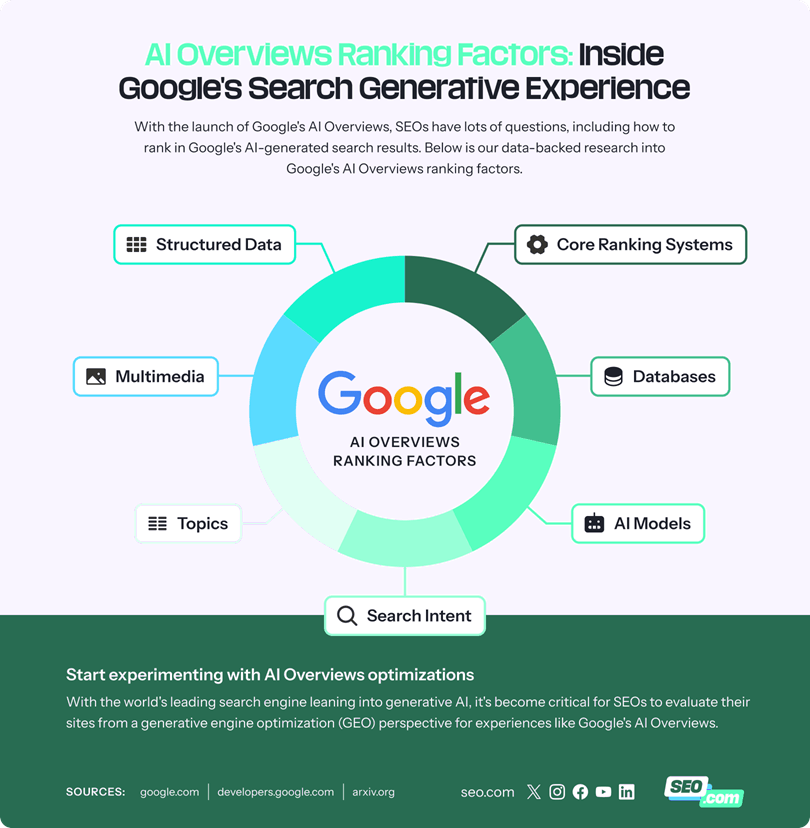
Download the full Google AI Overviews factors infographic here
Google AI Overview ranking factors in 2026
From our research, we discovered seven areas that power Google’s AI Overviews:
- AI models
- Core ranking systems
- Databases
- Topic
- Search intent
- Multimedia
- Structured data
- Query fan-out
Let’s break down each of these factors!
1. AI models
Status: ✅ Confirmed
Impact on rankings: 🔥 High
Overview: Google’s Gemini models power AI Overviews. Gemini 3 became the default AI Overviews model worldwide in January 2026.
Inside AI models
gle has since replaced PaLM 2, one of the first models it named for this feature, with its Gemini family. The models worth knowing today include:
- Gemini 3, which serves as the default model for AI Overviews. It brings the reasoning capabilities that first launched in AI Mode to the results page. It also lets searchers ask a follow-up question right from an AI Overview and continue the conversation in AI Mode.
- Gemini 3.5 Flash, which Google made the default model for AI Mode at I/O 2026. AI Overviews and AI Mode now work as one connected experience. A searcher can start with an AI Overview and end several follow-ups deep in AI Mode, with your content cited (or not) at each step.
- MUM, which Google still uses for specific applications, like improving featured snippet callouts, rather than for general ranking.
How to optimize for this ranking factor
Optimizing for the LLMs behind AI Overviews starts with understanding its view of you and your content.
Upload content to an LLM, whether Gemini or ChatGPT, to determine how well it understands your content. You might need to make improvements like:
- Updating word choices to improve readability
- Adding citations or quotes from reputable sources
- Starting initiatives to attract more customer feedback via online reviews
We’ll talk more about these updates in the ranking factors below!
2. Core ranking systems
Status: ✅ Confirmed
Impact on rankings: 🔥 High
Overview: AI Overviews are impacted by the core ranking systems. Google’s core ranking systems include high-impact ranking factors like Spam detection, PageRank, Reviews, and Freshness.
Inside core ranking systems
Google uses more than 15 core ranking systems for Google Search (and AI Overviews), including:
- BERT
- Crisis information systems
- Deduplication systems
- Exact match domain system
- Freshness systems
- Link analysis systems
- Local news systems
- MUM
- Neural matching
- Original content systems
- Removal-based demotion systems
- Passage ranking system
- RankBrain
- Reliable information systems
- Reviews system
- Site diversity system
- Spam detection systems
Based on our research into AI Overview ranking factors, we believe it’s important to prioritize:
- Core helpfulness signals, which focuses on delivering “original, helpful content written by people, for people…rather than content made primarily to gain search engine traffic.” Note that Google does not penalize AI-generated content as a part of its Helpful content system.
- Link analysis systems, which include PageRank, focus on how pages link to one another to understand better the relationship between those pages and the purpose of the linked-to page.
- Reviews system, which rewards high-quality reviews and content with insightful analysis and original research, written by experts or enthusiasts who know the topic well. Its goals mirror the people-first standard now built into core ranking.
- Spam detection systems, which detect spam content and behaviors based on Google’s spam policies. These spam policies include black-hat SEO tactics like keyword stuffing, cloaking, link spam, and more, and do apply to AI responses.
Note — while MUM is important, we’ve categorized it as a separate ranking factor under AI models.
Sites that perform well in Google Search are more likely to appear in AI Overviews.
How to optimize for this ranking factor
Since sites that perform well in Google Search (and practice SEO) are more likely to appear in AI Overviews, optimizing for this AI Overviews ranking factor focuses on familiar optimizations for SEOs, like:
- Attracting authoritative backlinks with helpful content, like guides, tools, and blog posts.
- Producing helpful content that demonstrates E-E-A-T, using components like quotes, citations, and unique takes.
- Improving content readability, like by including explanations and using simpler terms.
- Providing a user-friendly experience, like by improving usability and page speed.
- Earning online reviews, like via Google Business Profile, social media sites, or your site.
- Following SEO best practices, like keyword integration, HTTPS, and more.
3. Databases
Status: ✅ Confirmed
Impact on rankings: 🌡️ Medium
Overview: AI Overviews cites Google’s Knowledge Graph as a place it pulls information from. While Knowledge Graph catalogs people, places, and things, Shopping Graph maintains a products and sellers database via Google Merchant Center and indexed URLs.
Inside databases
Besides its massive search index, Google maintains other databases that affect AI Overviews, including:
- Google Shopping Graph, which Google calls the world’s most comprehensive product catalog. It holds more than 60 billion product listings, and Google refreshes more than 2 billion of those listings every hour. Google’s generative AI guide confirms that AI responses can include product listings and product information.
- Knowledge Graph, which is a database containing “billions of facts about people, places, and things.” While unconfirmed as an AI Overview ranking factor, the LLMs behind this technology reference Google’s Knowledge Graph database to generate responses.
Between these two databases, Google Shopping Graph deserves the most attention. The Shopping Graph provides an opening for attracting, nurturing, and converting users using AI Overviews. Whether offering a product or service, that potential influence on user behavior is invaluable.
How to optimize for this ranking factor
The following tips can help optimize your site for this ranking factor:
Get a Knowledge Panel
Claiming a Google Knowledge Panel is easy. Getting one is another story, and that story involves steps like:
- Creating an entity page, like a homepage or about page
- Updating the page with a description plus factual information
- Adding organization schema markup
- Including external links from reputable sources that discuss your business
- Earning external backlinks to the entity page, like from Wikipedia and Google Business Profile
Once recognized as an entity, a search for your business will generate the panel for claiming.
Use Google Merchant Center
Google Merchant Center is a go-to resource for Google Shopping Graph — so use it. While targeted toward ecommerce stores, retail businesses can also use Google Merchant Center to generate online visibility and offline conversions.
With integrations for Shopify and WooCommerce, it’s easy to join Google Merchant Center. Alternative options include adding products via a website URL or an uploaded file, which can create more ongoing maintenance for you.
Maintain up-to-date product listings
Freshness is vital for Google Merchant Center and Google Shopping Graph. Ensure product listings remain updated with automated syncs via ecommerce integrations like Shopify or internal processes to improve your chances of ranking in AI-powered snapshots.
Note: While product schema is an important optimization for this ranking factor, we’ve categorized it under a separate ranking factor, structured data.
4. Topic
Status: ✅ Confirmed
Impact on rankings: 🌡️ Medium
Overview: The topic impacts AI Overviews appearing, but also impacts your ability to rank in them. More sensitive areas, like YMYL topics, are under greater scrutiny and information will only appear in the AI Overviews if Google feels confident about its authenticity.
Inside topics
The topics you target influence the difficulty level for appearing in AI Overviews. Some topics and sectors are higher risk and more sensitive than others (healthcare, for example), while others are low-risk options where AI Overviews show up more freely.
For businesses in the following sectors, topics is a critical AI Overviews ranking factor:
- Finance
- Health
- Government and civic information
- Legal
Because these industries address “Your Money or Your Life” (YMYL) topics, Google approaches them differently in AI Overviews. Google even recently updated their YMYL definitions to provide further clarification and examples to ensure only accurate information appears in the AI Overviews.
All of that to say: The topics you target may impact the difficulty level for appearing in AI Overview.
How to optimize for this ranking factor
Learn how to optimize for topics, both in and outside YMYL, with these findings from a recent study:
Use an authoritative tone
An authoritative but not commanding tone can demonstrate expertise, like in the example below:
| Query | Original content | Revised content |
| Did the Jacksonville Jaguars ever make it to the Super Bowl? | The Jaguars have never appeared in the Super Bowl. They have 4 divisional titles to their name. | It is important to note that the Jaguars have never made an appearance in the Super Bowl. However, they have achieved an impressive feat by securing 4 divisional titles, a testament to their prowess and determination. |
With this tactic, the researchers saw an 89% improvement in visibility.
If you look at Google’s AI Overviews for this query, it’s even more authoritative:
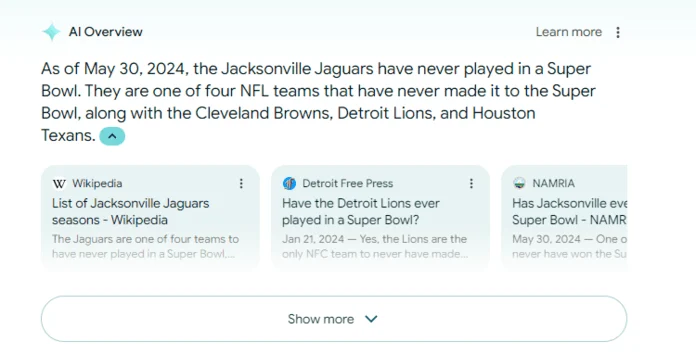
The result uses an authoritative tone plus leverages the optimization listed below (data points).
Share vetted data points
Trusted data points can also bring authority to content, as demonstrated by the case study below:
| Query | Original content | Revised content |
| Should robots replace humans in the workforce? | Not here, and not now — until recently. The big difference is that the robots have come not to destroy our lives, but to disrupt our work. | Not here, and not now — until recently. The big difference is that the robots have come not to destroy our lives, but to disrupt our work, with a staggering 70% increase in robotic involvement in the last decade |
The addition of a statistic generated a 65% improvement in visibility.
Backing up your content with data is a great way to boost content authority and back up what you’re saying about a topic.
Cite trusted sources
The biggest visibility gain for AI-generated search results came from citations like the following:
| Query | Original content | Revised content |
| What is the secret of Swiss chocolate? | With a per capital annual consumption averaging between 11 and 12 kilos, Swiss people rank among the top chocolate lovers in the world. | With a per capital annual consumption averaging between 11 and 12 kilos, Swiss people rank among the top chocolate lovers in the world (According to a survey conducted by The International Chocolate Consumption Research Group [1]) |
In response, the researchers saw a 132% increase in visibility.
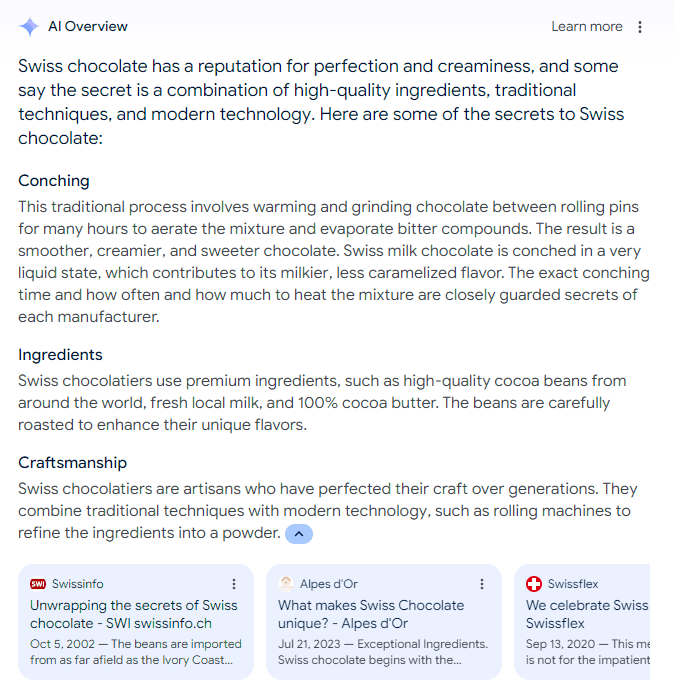
If you generate the AI Overviews, no immediate citation is included. Look at the site cited, though. The first is noted as being certified and in compliance with a reputable organization, the Journalism Trust Initiative.
5. Search intent
Status: ✅ Confirmed
Impact on rankings: 🔥 High
Overview: Based on experiments, search intent, like navigational, informational, or transactional, will also influence which websites rank. While informational and transactional searches will often have more diversity, navigational searches will focus more on the brand and its online reputation.
Inside search intent
The goal of AI Overviews is to help people quickly get information about a topic. It’s a jumping-off point for people to dig deeper.
That means delivering content that matches search intent is crucial for ranking in AI Overviews. You can focus on a hub-and-spoke model to meet a user’s initial need while offering jumping-off points, like learning what SEO is and then jumping off to learn how to do SEO.
How to optimize for this ranking factor
Use the following tips to optimize for this AI Overview ranking factor:
Target snapshot gaps
While AI Overviews aim for diversity (remember, one of Google’s core ranking systems is site diversity), there is still value in using these snapshots to spot content gaps based on the information cited.
Research user journeys
With AI Overviews, search is more than reaching users at the right time — it’s reaching them at the right time and anticipating their next move. Dig into user journeys, prompt AI models, and more, to better understand how a journey starts and ends.
Use search features to spot jumping-off points
With People Also Ask and AI Overviews, it’s possible to discover jumping-off points. You can also use free or paid keyword research tools to uncover other related queries, which can become topics for your site.
Develop skyscraper content
Create comprehensive guides that answer a user’s initial search intent and those jumping-off points with skyscraper content. Your content could then appear in multiple AI-powered snapshots, including jumping-off point responses.
For example, based on AI Overviews, a guide on roofing types should consider covering:
- Common roofing materials
- Details and qualities about each type
- Considerations when choosing a roofing material
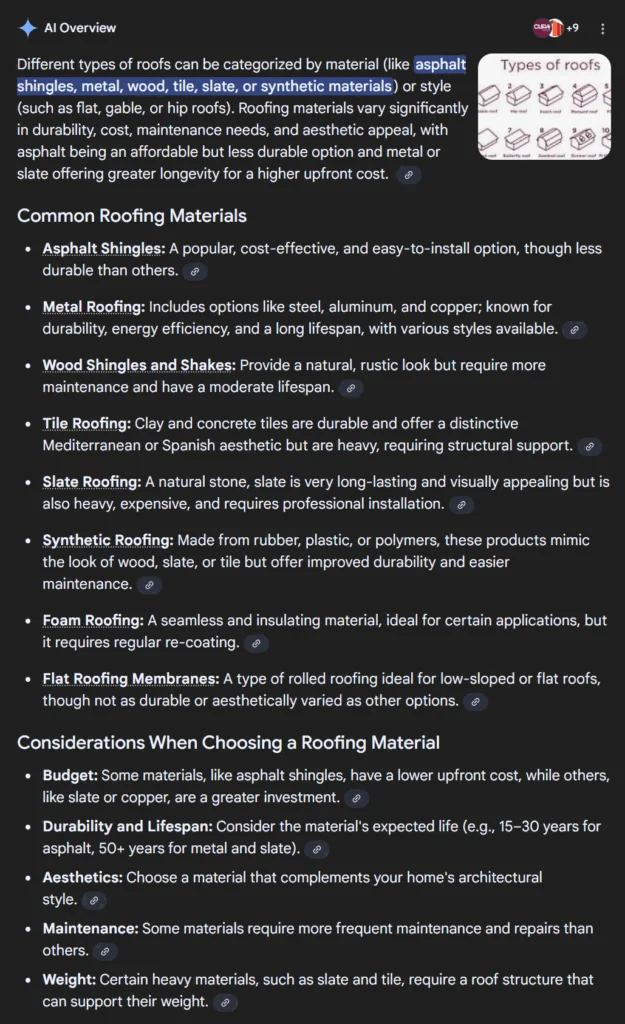
You can create effective content targeting a user’s journey with the above information.
Prioritize readability
Understanding is critical to AI Overview rankings, with a recent study finding that simplifying language improved AI Overview rankings. When possible, use an 8th- to 11th-grade reading level to create easy-to-understand content for users and AI to summarize.
6. Multimedia
Status: 📈 Likely
Impact on rankings: 🧊 Low
Overview: AI Overviews will include visuals in its results (along with links to the source). They’re typically images or videos relevant to the topic.
Inside multimedia
LLMs like Gemini are multi-modal — they can understand text, images, videos, and voice. Bringing those formats (if relevant) to your content can provide the LLMs behind AI Overviews with valuable context and information for AI-powered results.

On top of that, AI Overviews often integrates these visuals into the search results. With the example above, you can see that there’s both an image and a video for this query. So, integrating these elements (when relevant) can be a way for you to get pulled into AI Overviews.
How to optimize for this ranking factor
Experiment with bringing multimedia to your SEO strategy with these tips:
Leverage visual search intent
When considering search intent, SEOs focus on producing text-based answers, overlooking visual search intent. For example, when someone is researching something like “types of garage doors,” they’re looking for more than a definition — they want to see what they look like.
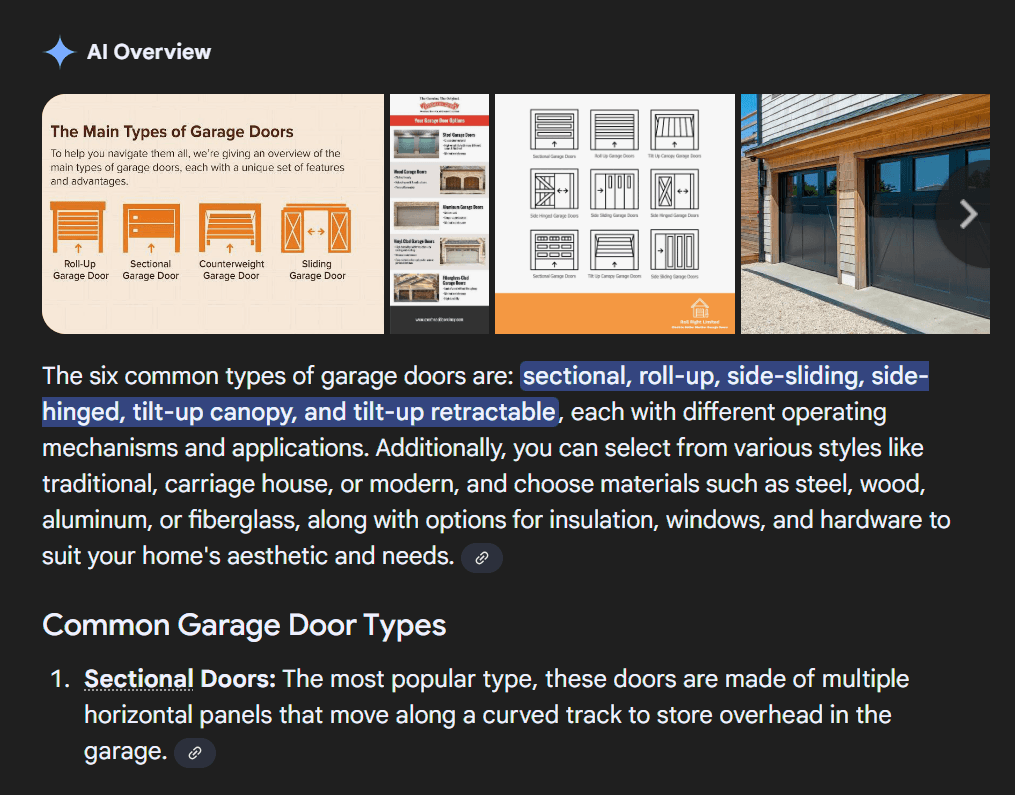
You can see in the example above that there are multiple image options to show people different types of garage doors.
So, when creating SEO content, consider the visual side of the search intent and how to target it.
Use snapshots for image idea generation
Get additional ideas for targeting visual search intent by referencing how an AI Overview answers queries to develop image ideas. Besides generative search results, Google’s image search results can be used to find additional ideas.
Experiment with AI image generation
You don’t need design skills to develop compelling images for search. With paid or free AI image generation tools, it’s possible to generate helpful graphics or visuals (ChatGPT can even create charts!).
Host videos on YouTube
Our research found that YouTube videos appear more in AI Overviews than URLs with YouTube-embedded videos. Continue to use YouTube-embedded videos while also optimizing these uploads for YouTube SEO.
Follow image SEO best practices
These best practices include compressing images (which improves page experience) and adding image alt text (which helps search engines and users understand the visual). For more information on image SEO, check out our image SEO guide.
7. Structured data
Status: 📈 Likely
Impact on rankings: 🌡️ Medium
Overview: According to Google, structured data provides “explicit clues about the meaning of a page” and is referenced by Google Shopping. With structured data, websites can provide Google’s databases and LLMs with more explicit information about a page.
Inside structured data
While not confirmed as a ranking factor, structured data is invaluable to search engines like Google in understanding a page. With structured data, websites can provide more information about their content, products or services, and offerings to Google and LLMs.
If businesses can help LLMs better understand their content and offerings, LLMs can better reference that content in AI Overviews, which can help your site get invaluable visibility.
How to optimize for this ranking factor
Optimizing for this AI Overviews ranking factor revolves around generating, implementing, and maintaining schema markup. You’ll find lots of structured data options. We recommend starting with these options (if applicable):
- Product markup: Besides Google Merchant Center, Google uses information across its search index to build its Google Shopping Graph. Use Product markup to give Google definitive information about your offerings, like price, rating, inventory, and more.
- LocalBusiness markup: AI Overviews are also available for local searches. Use LocalBusiness markup to provide Google with explicit information about your company’s name, address, and phone number.
- Organization markup: Since AI Overviews emphasizes authoritative and reliable content, use Organization markup to provide essential business information, like your company’s name, phone number, and website URL.
Additional schema markup options include:
For more information on how to generate structured data, view our schema markup guide.
8. Query fan-out
Status: ✅ Confirmed
Impact on rankings: 🔥High
Overview: AI Overviews and AI Mode uses a technique called query fan-out. Google runs a set of related searches across subtopics in the background to build a single response. That process lets Google cite a wider, more diverse set of pages than a classic search would.
Inside query fan-out
When someone searches, Google’s model generates several related queries at once and pulls results for each. For example, a search like “best standing desk for a small apartment” might fan out into queries about standing desk dimensions, the quietest motorized models, and weight limits for dual monitors.
Your page doesn’t have to rank first for the original query to earn a citation. If it gives the best answer to one of those fan-out queries, it has a shot at appearing in the response.
Fan-out matters even more now that AI Overviews and AI Mode work as one experience. A follow-up question can kick off a new round of related searches, and each round is another chance for your content to get cited.
How to optimize for this ranking factor
-
Map the subtopics behind your target queries: Use People Also Ask, AI Overviews, AI Mode follow-up suggestions, and keyword research tools to find the questions searchers ask next. Then check whether your page answers them.
-
Cover subtopics on one strong page: Organize related subtopics under clear headings on a single, comprehensive page. Don’t spin up a separate page for every fan-out variation. Google’s guide says that creating content primarily to manipulate rankings or AI responses this way violates its scaled content abuse policy.
-
Answer each subtopic clearly: Lead each section with a direct answer, then back it up with specifics like data, examples, or first-hand experience. You don’t need to break content into tiny “chunks.” Google says its systems can find the relevant section of a well-organized page on their own.
-
Track your generative AI visibility: Use the Generative AI performance report in Google Search Console to see which pages earn visibility in AI Overviews and AI Mode.
Our methodology: How we determined Google’s AI Overview ranking factors
Like our research into Google’s search algorithm, we dug into official documents, academic studies, and experiments to determine what powers Google’s AI Overviews — Seo-Mall (the team behind Seo-Mall) also actively experiments with optimizing for these factors to see what works — and what doesn’t.
We also used our real client case studies and results to determine which factors contributed to better AI Overview visibility, as well as traffic, leads, and conversions from AI sources. Check out some of our case studies below:
| Ranking Factor | Case Study | Tactic | Result |
| Core ranking systems | Thompson Tractor | Found which sources AI Overviews already cited, then earned links in those same sources (43 links, 6 targeted at AI) | 586% AI-source traffic increase; cited by 10/10 tracked LLMs |
| Core ranking systems | 10X Engineered Materials | Expert FAQs/guides built for AI consumption, syndicated to 229+ outlets for authority | 37% increase in AI answer appearances |
| Core ranking systems (Authority/trust) | URAC | Expert-written healthcare content + authority link outreach; explicit goal of becoming a cited LLM source | 188% AI channel traffic increase; 95% visibility on tracked AI questions |
| Core ranking systems (E-E-A-T) | Enabling Devices | 190+ content assets, ~70 links, “doubled down on authoritative backlinks and brand mentions” | 542% increase in AI/OmniSEO leads |
| Query fan-out | Thompson Tractor | Built content around specific buyer comparison queries (“excavator vs. bulldozer”) instead of broad category pages | #1 Copilot ranking on a long-tail query |
| Query fan-out / Topic | RC Mowers | Longform, application-specific content on narrow subtopics (slope mowing, canal mowing, municipal mowing) | Slope-mowing page ranked for ~200 keywords within 1 month |
| Search intent | IGX Solutions | Ran search-intent audits, remapped existing pages to matched AI answers, updated titles “for query alignment” | 53% increase in AI chatbot appearances |
Check if your site appears in AI Overviews
So, now that you know the answer to the question, “what are the ranking factors for Google AI Overviews”, let’s get into how to check if your site is actually in them!
Are you unsure if your website is appearing in AI Overviews? Our free AI Overview Checker will let you know! Not only that, it will display some crucial information for how organic results are informing the AI Overviews, and how your site can improve.
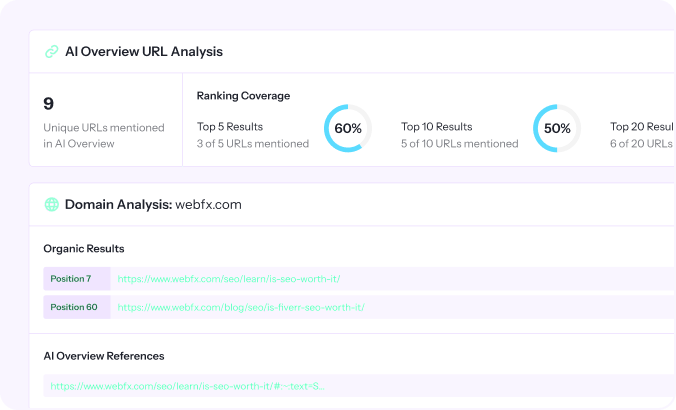
Start experimenting with AI Overview optimizations
With the world’s leading search engine leaning into generative AI, it’s become critical for SEOs to evaluate their sites from a generative engine optimization (GEO) perspective for experiences like Google’s AI Overviews.
Prepare for this new search feature by experimenting with these AI Overview optimizations now! For professional assistance, connect with us online to learn how our award-winning team can optimize your site with our AI Overview optimization services!

Track Rankings Beyond Search
Your prospective customers are searching in AI engines beyond traditional search. Are you ranking?



Future-Proof Your SEO Strategy with OmniSEO®
Goodbye search engine optimization, hello search everywhere optimization.

Future-Proof Your SEO Strategy with OmniSEO®
Goodbye search engine optimization, hello search everywhere optimization.
Writers



Free download: Google AI Overviews Ranking Factors Guide
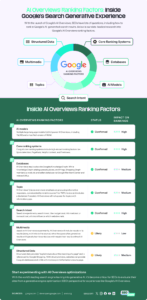
Download it now!